A Different Approach to Wireless Mesh
HOTMesh™ is not a commodity radio module or generic mesh stack. It is an OEM-focused wireless mesh protocol engineered around a specific operational premise: for distributed systems where path quality before transmission matters more than brute-force bandwidth.
How HOTMesh™ Routes, Adapts, and Scales

Pre-Transmission Path Evaluation
HOTMesh™ evaluates available paths before committing a transmission. Route selection is based on the highest-quality path to the destination at the time of transmission, not a fixed routing table or a generic flood-and-filter approach. The result is a network that maintains stability and predictable behavior under real-world conditions: node addition, node loss, interference, and varying RF environments.
Mesh Resilience
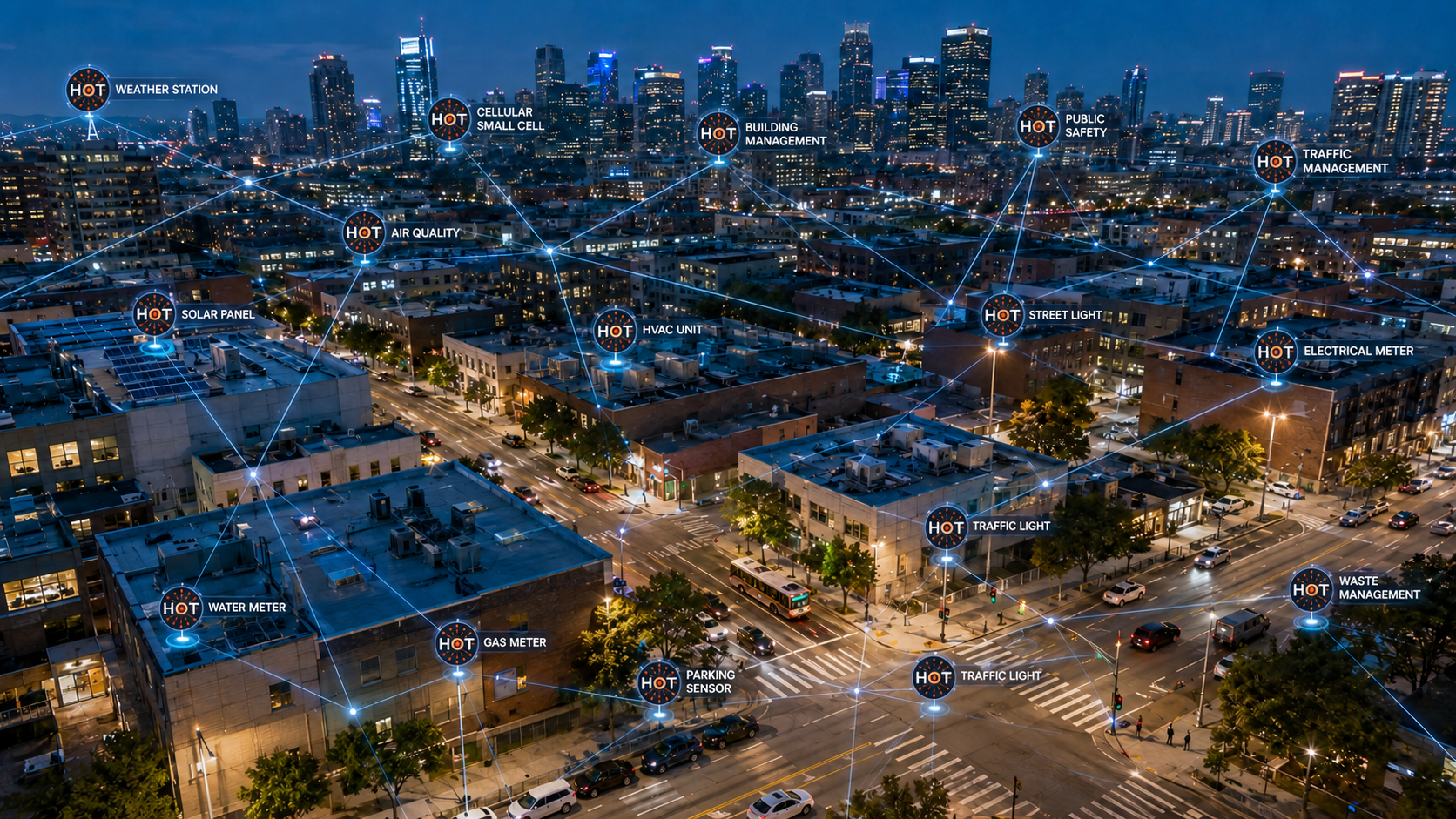
There is no single point of failure in a HOTMesh™ network. As nodes are added, removed, or become unavailable, the mesh adapts. This is particularly relevant for deployments where physical access to individual devices is limited or service calls are costly.
Technical Characteristics
- Up to 1,000 nodes per gateway
- Multi-gateway expansion for larger deployments
- AES 256-bit encryption
- OTA firmware update support across all nodes
- Device supervision and network health visibility
- Self-healing mesh with dynamic path reconfiguration
- Protocol-flexible architecture not dependent on a single RF band
- Supported interfaces: I2C, BLE, Zigbee, Matter, Thread. Additional interfaces available through direct consultation with 78Dragons engineering.
Range, Frequency, and Where HOTMesh™ Belongs
RF and Frequency
2.4 GHz ISM is the current practical deployment frequency for many HOTMesh™ use cases. The protocol architecture is not defined by or limited to a single frequency band. Future deployment configurations may extend beyond 2.4 GHz based on hardware, regulatory, and product architecture requirements.
In field testing, HOTMesh™ demonstrated communication distances of approximately 1,442 feet using an integrated internal antenna and approximately 4,189 feet using a 3 dB external SMA antenna in a non-elevated configuration. Actual performance varies by deployment environment, terrain, building materials, RF interference, node placement, and antenna configuration.
What HOTMesh™ Is Designed For
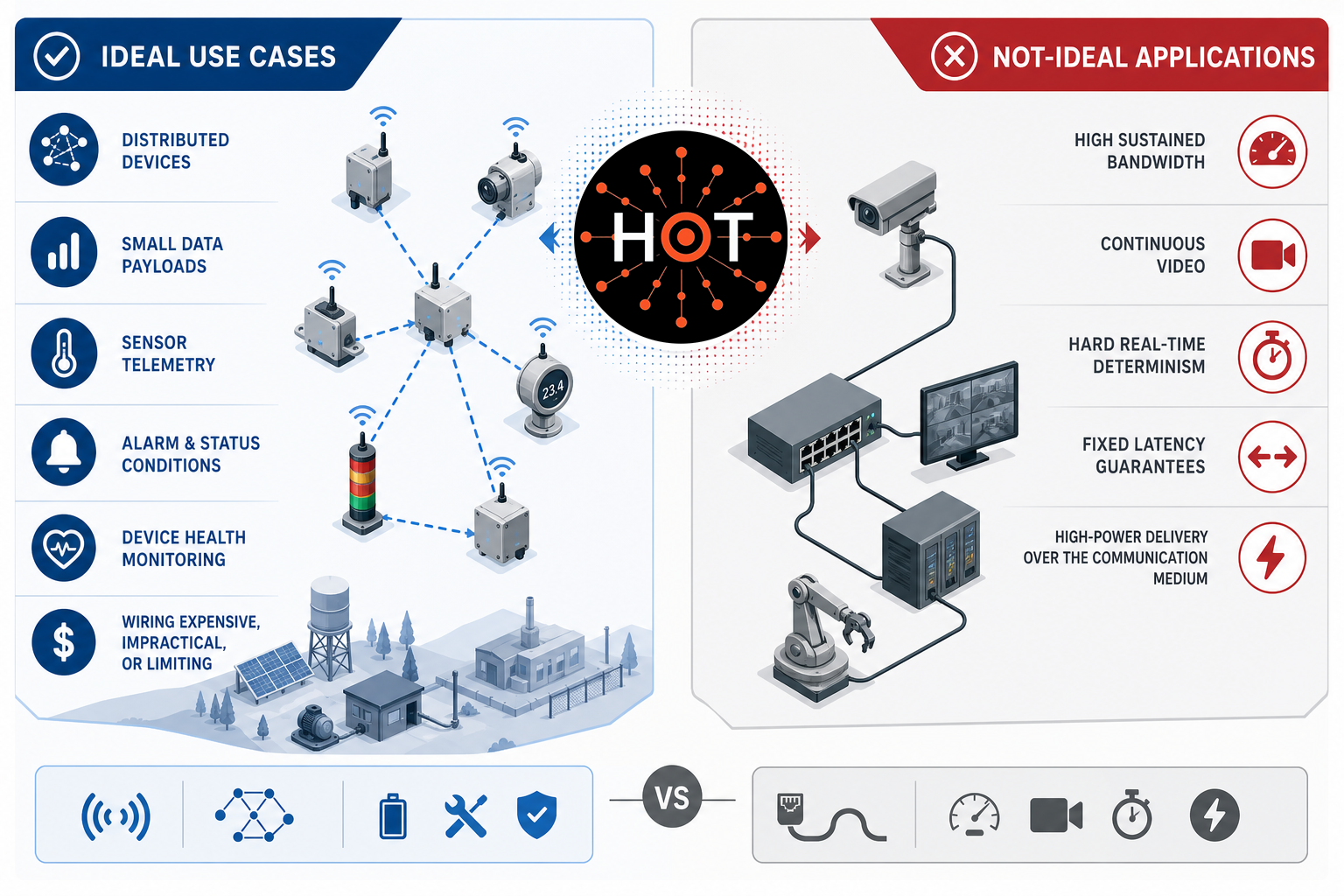
The strongest HOTMesh™ use cases involve distributed devices, small data payloads, sensor telemetry, alarm and status conditions, device health monitoring, and environments where wiring is expensive, impractical, or limiting. Applications requiring high sustained bandwidth, continuous video, hard-real-time determinism with fixed latency guarantees, or high-power delivery over the communications medium may be better served by wired alternatives.